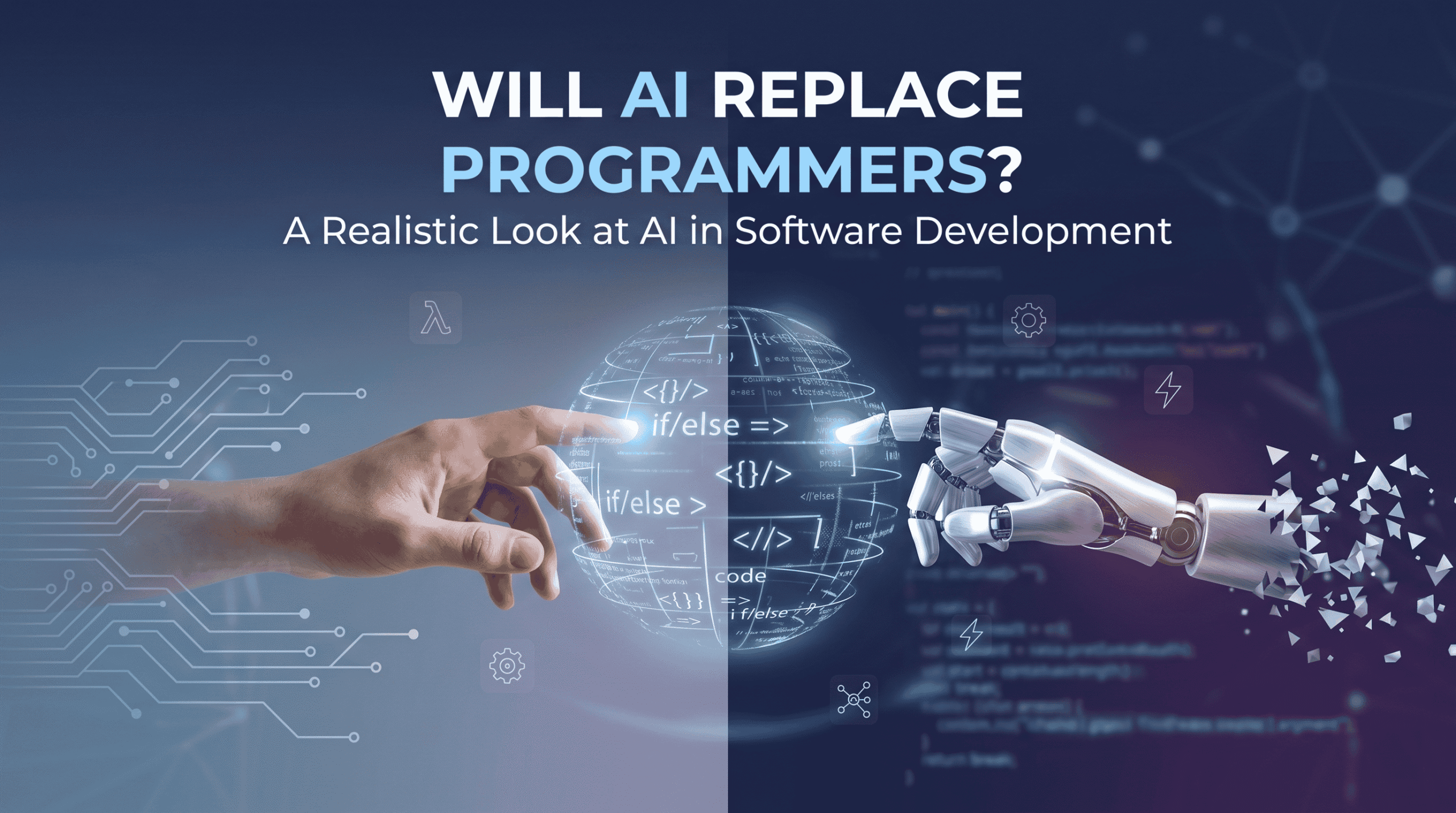
Artificial Intelligence is one of the hottest topics in tech right now. Everywhere we look, we hear bold statements from AI company CEOs and tech influencers claiming that programmers will soon be replaced by AI.
But how true is that?
Some developers believe AI will eventually replace most programming jobs. Others completely disagree. The truth is probably somewhere in between.
No one can predict the future with certainty, but we can look at the history of software development to better understand what might happen next.
#We’ve Seen This Pattern Before
If you are familiar with programming history, you know that similar fears have appeared many times before.
When the C programming language was introduced, it was considered a huge breakthrough. Before C, developers mostly worked with Assembly language, which was much closer to machine code and far more difficult for humans to use.
At the time, many people believed programming would become so easy that “everyone could do it,” making programmers less valuable.
That never happened.
Instead, software development expanded rapidly, and even more job opportunities were created.
The same thing happened again with Python.
People said programming was becoming “just writing English,” and since everyone could speak English, developers would eventually become unnecessary.
But again, the industry grew even larger.
#WordPress, Website Builders, and the Same Fear
When WordPress became popular, many believed web designers and developers would disappear because people could build websites without coding.
Later, tools like Elementor and other website builders created another wave of concern.
But instead of destroying the market, they changed it.
New opportunities appeared:
- WordPress theme development
- Plugin development
- Website customization services
- Template marketplaces
- SaaS products built around WordPress
Companies like WooCommerce turned this ecosystem into massive businesses.
Web development did not disappear. The market simply evolved.
#AI Is Changing Development But Not Eliminating It
Today, AI seems to be following the same pattern.
Modern AI tools can:
- Speed up development
- Automate repetitive tasks
- Generate boilerplate code
- Explain algorithms
- Debug common issues
- Improve productivity
In many ways, AI is becoming another evolution in software development tools, just like WordPress, Elementor, or high-level programming languages were in the past.
But the real question is:
#What Matters More The Tool or the Thinking Behind It?
What actually separates a great programmer from an average one?
Is it typing speed?
Is it memorizing more syntax?
Is it having more ready-made code snippets?
Not really.
The biggest difference is usually:
- Problem-solving ability
- Experience
- System design thinking
- Creativity
- Communication skills
- Understanding real-world business problems
These are skills developed through years of experience and challenges.
AI can generate code, but it does not truly understand problems the way humans do. It does not have personal experience, intuition, ownership, or genuine creativity.
Even when AI produces something impressive, it is usually based on patterns learned from existing data rather than true innovation.
#So, Will AI Replace Programmers?
My realistic answer is: not entirely.
AI will definitely change the software industry. Some jobs and repetitive tasks may disappear. The market will evolve, just like it always has.
But developers who continue learning and adapt to new tools will likely become even more productive and valuable.
The programmers most at risk are:
- Developers who completely ignore AI and refuse to use it
- Developers whose skills are limited to tasks AI can already handle efficiently
In the future, many programmers may not be replaced by AI itself, but by other programmers who know how to use AI effectively.
#Final Thoughts
AI is not the end of programming.
It is another major shift in the evolution of software development.
And just like previous shifts, it will probably create new opportunities for developers who are willing to adapt, learn, and improve their skills.
The best approach is not fear.
It is learning how to work alongside AI while continuing to develop the human skills that machines still cannot replace.